NASA's Most Powerful Antenna Is Offline After a Preventable Accident
Staff article, AI assisted
NASA has released a formal mishap investigation report detailing how DSS-14, the agency's most capable 70-meter deep space antenna, sustained between $4.1 and $4.6 million in damage on September 16, 2025, and remains offline as repairs continue.
The antenna, located at the Goldstone Deep Space Communications Complex in California's Mojave Desert, over-rotated beyond its design limits while tracking NASA's Juno spacecraft. The over-rotation severely damaged the antenna's internal cable wrap, a complex bundle of power cables, data lines, and fluid hoses that runs between the antenna's stationary base and its rotating structure. When the cables and hoses failed, an estimated 200,000 gallons of water, some of it contaminated with glycol coolant, flooded the antenna's base. No injuries were reported.
What is DSS-14 and why does it matter?
DSS-14, nicknamed "Mars" for the site where it sits at Goldstone, is one of the most significant antennas in human spaceflight history. Originally built as a 64-meter dish in 1966 and upgraded to 70 meters in 1988, it is part of NASA's Deep Space Network, the global system of large radio antennas that maintains communication with virtually every spacecraft NASA has ever sent beyond Earth orbit. The DSN operates three complexes worldwide, at Goldstone in California, Madrid in Spain, and Canberra in Australia, providing near-continuous coverage as the Earth rotates.
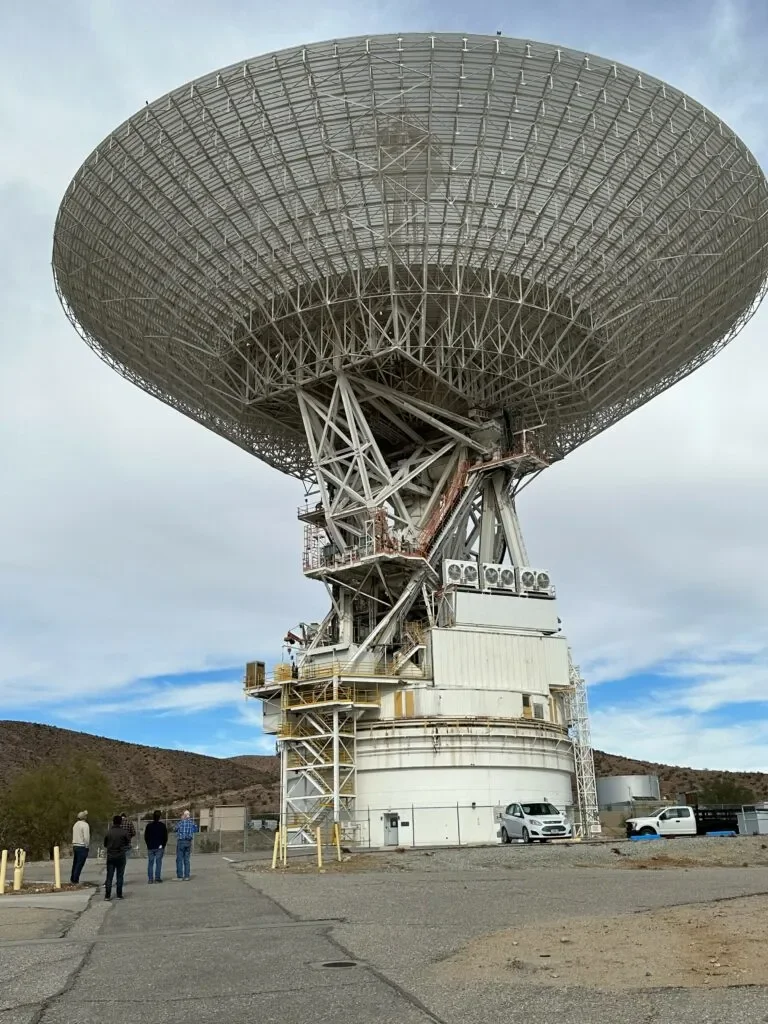
Image credit: science.nasa.gov
DSS-14 is the largest antenna in the Goldstone complex and one of only three 70-meter antennas in the entire DSN. At that size, it can communicate with spacecraft at the edges of the solar system, receive faint signals from Voyager 1 and Voyager 2 more than 15 billion miles away, and support planetary radar observations. Its loss represents a significant reduction in NASA's deep space communications capacity at a particularly demanding time, with active missions including the Juno spacecraft at Jupiter, the Voyager probes, and the ongoing Artemis program.
How it happened
The report identifies a cascade of failures over a 24-hour period preceding the mishap. The day before, maintenance personnel were troubleshooting a problem with the antenna's emergency stop system. During that work, multiple safety systems were inadvertently compromised. By the morning of September 16, operators at the Goldstone control room were repeatedly driving the antenna into its rotation limits and manually recovering it each time, without fully understanding why the limits kept triggering or what state the antenna's safety systems were in.
Critically, the antenna's hydraulic limit system, described in the report as the final failsafe against over-rotation, had been damaged in an earlier undocumented incident and was completely inoperable. The investigation board found no evidence that this system had been functionally tested in more than 20 years. When operators finally sent the antenna to track the Juno spacecraft, it rotated past all limits with nothing to stop it.
Making matters worse, after flooding was discovered, a command was issued to move the antenna to its standard stow position, which rotated it further into the over-wrap condition, causing additional damage.
What the investigation found
The Mishap Investigation Board identified four root causes: inadequate training of Goldstone personnel, insufficient written procedures, control logic that failed to give operators a clear picture of the antenna's state, and an over-reliance on undocumented institutional knowledge. The report is pointed in its assessment of the culture at Goldstone, describing a workplace that "prioritized a rapid return to operations over the health of assets or personnel" and that rewarded personnel for improvising outside their training rather than following established procedures. Operators were described as willing to "do whatever it takes to keep the antenna running," an attitude the board characterized as directly contributing to the mishap.
The board also noted that the antenna's emergency response plan had not been updated in more than 14 years, that safety procedures were routinely bypassed, and that four employees walked through the flooded antenna structure before electrical power was shut off.
Twenty recommendations were issued covering training reform, procedure updates, cultural change, hydraulic system remediation, and restored authority for supervisors over on-site technical staff.
What happens next
DSS-14 remains offline. The report indicates the unwrapping procedure was completed in November 2025, but full repair and return to service will require replacement of all 11 fluid hoses, at least 85 of 114 data and power cables, all 56 structural connecting rods, and extensive inspection and recertification of remaining components. Asbestos abatement is also required in portions of the antenna base damaged by flooding.
The loss of DSS-14 puts additional strain on the remaining two 70-meter antennas in the DSN network at Madrid and Canberra, and on the smaller 34-meter dishes at Goldstone, at a time when the number of active deep space missions requiring DSN support continues to grow.
Source: NASA Mishap Investigation Board Report, DSS-14 Azimuth Over-Rotation Mishap, March 30, 2026